We have already learned several ways to make alcohols. We will review them here.
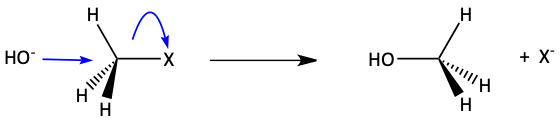
The SN2 reaction of hydroxide with an alkyl halide
Acid hydration of an alkene
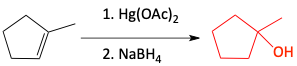
Markovnikov Oxymercuration & Demercuration of an alkene in water
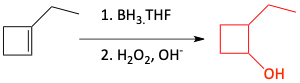
Anti-Markovnikov hydroboration of an alkene
Syn-dihydroxylation of an alkene using osmium tetroxide
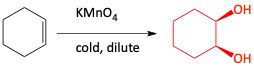
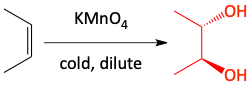
Syn-dihydroxylation of an alkene using potassium permanganate
Epoxidation of an alkene followed by acid hydrolysis
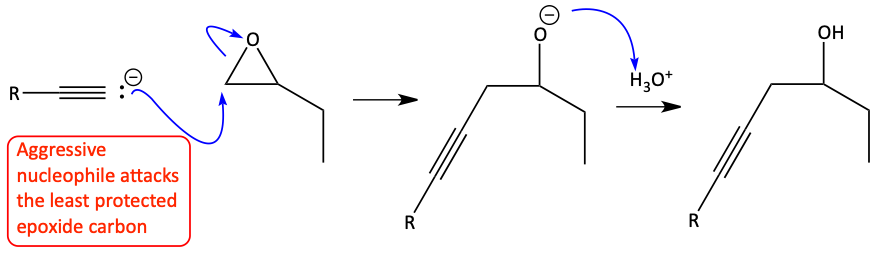
Acetylide attack of an epoxide
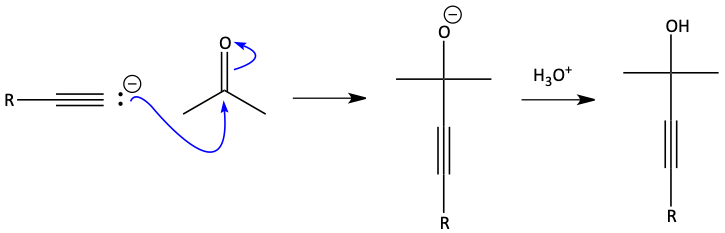
Acetylide attack of a carbonyl
2. Fill in the blank for the missing reagents in the following reactions.
A) 1. Hg(OAc)2 or H+, H2O (H3O+) 2. NaBH4 B) 1. BH3.THF 2. H2O2, OH- C) RCO3H in H2O D) 1. OsO4 or KMnO4, OH- (cold, dilute) 2. H2O2 E)
F)
3. Draw the products of the following reactions. a) 1-methyl cyclopentene with Hg(OAc)2 followed by NaBH4 b) 1-ethyl cyclobutene with BH3.THF followed by hydrogen peroxide and hydroxide c) Cyclohexene with cold, dilute KMnO4 d) cis-2-butene with a peroxyacid in water e) pentyne reacted with sodium amide followed by benzaldehyde (PhCHO) and then quenched with acid and water